
Recognition and Enforcement of Foreign Arbitral Awards in West Africa: A Comparative Analysis of the New York Convention Framework in Nigeria, Ghana, Benin and Burkina Faso
Toheeb Amuda
September 28, 2026
West Africa, Recognition and Enforcement, New York Convention, Nigeria, Ghana, Benin, Burkina Faso, OHADA, Public Policy
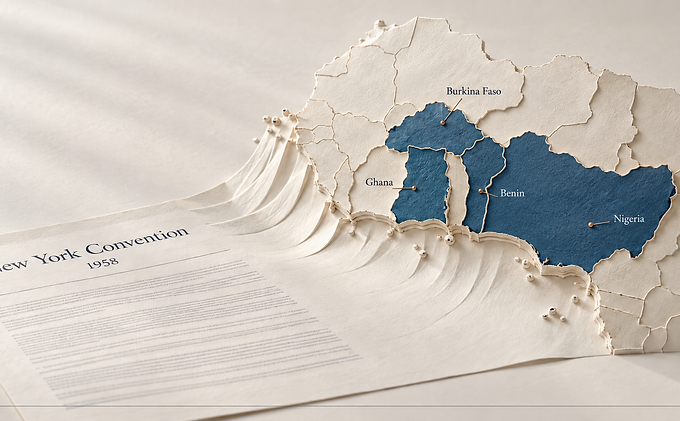
This image is AI generated
The New York Convention
The Convention on the Recognition and Enforcement of Foreign Arbitral Awards, adopted at New York on 10 June 1958 (the “New York Convention”), constitutes the principal international framework governing the recognition and enforcement of foreign arbitral awards. It entered into force on 7 June 1959 and currently has 172 Contracting States. Its central objective is to establish common standards for the recognition and enforcement of foreign arbitral awards and, correspondingly, to prevent national courts from subjecting foreign awards to substantially more onerous conditions than those applicable to domestic awards.
The Convention establishes a relatively simple enforcement architecture. Article III imposes the general obligation on Contracting States to recognise arbitral awards as binding and enforce them in accordance with the procedural rules of the State in which enforcement is sought. Article IV establishes the documentary requirements for recognition and enforcement, principally the duly authenticated original award or certified copy and the original arbitration agreement or a duly certified copy. Article V then identifies the limited grounds upon which recognition and enforcement may be refused such as incapacity of the parties or invalidity of the arbitration agreement, inadequate notice or inability to present one's case, an award dealing with matters outside the submission to arbitration, irregularity in the composition of the tribunal or arbitral procedure, and the award not yet being binding or having been set aside or suspended at the seat Within that framework, the Convention leaves questions of procedure and implementation to the State.
Nigeria
Nigeria acceded to the New York Convention on 17 March 1970, and the Convention entered into force for Nigeria on 15 June 1970. Nigeria acceded subject to the two principal Article I(3) declarations i.e. the reciprocity reservation and the commercial reservation. Nigeria declared that it would apply the Convention on the basis of reciprocity to awards made only in the territory of another Contracting State and to differences arising out of legal relationships, whether contractual or not, considered commercial under Nigerian law.
The Convention was subsequently incorporated into Nigerian arbitration legislation i.e. the Arbitration and Conciliation Act, Cap A18, Laws of the Federation of Nigeria 2004, and it appears in the Second Schedule, while section 54 provided for its application to awards arising out of international commercial arbitration. The current framework is the Arbitration and Mediation Act 2023 (“AMA”), which repealed the Arbitration and Conciliation Act. The AMA incorporates the New York Convention in its Second Schedule, while section 60 of the AMA provides for its application.
The AMA requires the party seeking enforcement to supply the original award or a certified copy, the original arbitration agreement or certified copy, and, where the award or agreement is not in English, a certified English translation. The award may then, by leave of the court, be enforced in the same manner as a judgment or order to the same effect (Section 57).
Recognition and enforcement nevertheless, remain subject to the grounds for refusal contained in the AMA (Section 58), which substantially reflect Article V of the Convention. Nigerian judicial practice thus, demonstrates substantial engagement with the Convention's pro-enforcement structure.
Ghana
Ghana acceded to the New York Convention on 9 April 1968, which entered into force for Ghana on 8 July 1968. Ghana did not make the reciprocity or commercial reservations under Article I(3) of the Convention. The Convention was incorporated into Ghanaian law through the Alternative Dispute Resolution Act, 2010 (Act 798). The Convention is reproduced in the First Schedule to the Act, pursuant to section 59(1)(c). Section 59 provides the statutory framework for the recognition and enforcement of foreign arbitral awards in Ghana and vests jurisdiction in the High Court.
Section 59(1) of the Ghana ADR Act provides that the High Court shall enforce a foreign arbitral award where, amongst other requirements, the award was made by a competent authority under the law of the country in which it was made, a reciprocal arrangement exists between Ghana and the country in which the award was made, or the award was made under the New York Convention or another international convention on arbitration ratified by Parliament. The party seeking enforcement must also produce the original award or an authenticated copy and the arbitration agreement or an authenticated copy. Moreover, where the relevant document is not in English, a certified true translation must be produced.
Section 59(3) sets out circumstances in which the High Court shall not enforce a foreign arbitral award which substantially reflect several grounds contained in Article V of the New York Convention.
Ghanaian judicial practice demonstrates a generally facilitative approach to the enforcement of Convention awards.
Benin
Benin acceded to the New York Convention on 16 May 1974, and the Convention entered into force for Benin on 14 August 1974. Benin did not make the reciprocity or commercial reservations identified in Article I(3) of the Convention.
Unlike Nigeria and Ghana, the legal framework governing arbitration and the recognition and enforcement of arbitral awards in Benin must be considered within the OHADA legal framework. Benin is a Member State of the Organisation for the Harmonisation of Business Law in Africa (OHADA) and is therefore subject to the OHADA Uniform Act on Arbitration 2017 (“UAA”), which constitutes the principal legislative framework governing arbitration in OHADA Member States. The UAA was adopted on 23 November 2017 and entered into force on 15 March 2018.
Article 34 of the UAA provides that arbitral awards rendered pursuant to rules different from those contained in the UAA shall be recognised in OHADA Member States under the conditions provided by applicable international conventions and, in the absence of such conventions, under the conditions provided by the UAA. Accordingly, in Benin, where the award falls within the scope of the New York Convention, the Convention operates as the applicable international framework for recognition and enforcement, while the UAA provides the regional arbitration framework and applies where no applicable international convention governs.
The recognition and enforcement of arbitral awards under the OHADA framework are principally addressed by Articles 30 to 34 of the UAA, together with the applicable provisions of Beninese Code of Civil, Commercial, Social, Administrative and Accounts Procedure. In relation to New York Convention awards, the applicable procedure operates through the interaction between Article 34 of the UAA and the relevant provisions of Beninese procedural law.
Article 31 of the UAA provides that recognition and exequatur of an arbitral award shall be refused where the award is manifestly contrary to international public policy. The party relying on the award must establish its existence by producing the original award accompanied by the arbitration agreement, or duly authenticated copies thereof. Where necessary, a certified translation must also be produced. The UAA further provides for determination of an application for exequatur within 15 days, failing which exequatur is deemed to have been granted.
The OHADA framework further provides for a limited avenue of challenge against an exequatur decision. A decision granting exequatur is not subject to appeal, while a decision refusing exequatur may be challenged before the Common Court of Justice and Arbitration (“CCJA”) on points of law. The CCJA consequently has an important role in ensuring uniform interpretation and application of the OHADA arbitration framework across Member States.
The Beninese courts have granted exequatur to arbitral awards and recognise and enforce foreign arbitral awards.
Burkina Faso
Burkina Faso acceded to the New York Convention on 23 March 1987, and the Convention entered into force for Burkina Faso on 21 June 1987. Burkina Faso did not make the reciprocity or commercial reservations identified in Article I(3) of the Convention.
Burkina Faso is also a Member State of OHADA and, consequently, the recognition and enforcement of arbitral awards are governed principally by the OHADA Uniform Act on Arbitration 2017 (“UAA”), together with applicable national procedural provisions. Burkina Faso also enacted Law No. 047-2017, which lays down the modalities for the intervention of State courts in arbitration proceedings.
As an OHADA Member State and a party to the New York Convention, Burkina Faso's framework for foreign arbitral awards is based on the interaction between the two regimes as described in the analysis of Benin above. Article 34 of the UAA provides that awards rendered pursuant to rules different from those contained in the UAA are recognised in OHADA Member States under applicable international conventions and, in their absence, under the conditions provided by the UAA. The New York Convention therefore provides the applicable international framework for awards falling within its scope.
The enforcement of foreign arbitral awards in Burkina Faso is subject to an exequatur process before the competent State court. Burkina Faso is not a party to the Hague Apostille Convention and, consequently, foreign arbitral awards require exequatur before they may be enforced.
The CCJA has an important role in the OHADA system applicable in Burkina Faso. Where the UAA governs the recognition or enforcement process, the appellate framework under the UAA provides for recourse to the CCJA in respect of a decision refusing exequatur.
Burkina Faso's judicial and legislative framework consequently provides a mechanism for the recognition and enforcement of foreign arbitral awards through the combined operation of the New York Convention, the OHADA UAA and applicable national procedural law.
Conclusion
The comparison of Nigeria, Ghana, Benin and Burkina Faso demonstrates that the New York Convention provides a common foundation for the recognition and enforcement of foreign arbitral awards across these West African jurisdictions, but that the practical operation of that framework is substantially influenced by domestic and regional law.
At the treaty level, the four States share the same fundamental Convention obligations including documentary requirements under Article IV and the principal grounds for refusal under Article V.
Ultimately, the judicial practice across the four jurisdictions gives practical effect to the Convention's objective of facilitating the recognition and enforcement of foreign arbitral awards, while preserving the limited grounds upon which enforcement may be refused.